

Solar lentigo is a common, benign, flat, pigmented lesion found predominantly on sun-exposed skin. It develops as a result of chronic exposure to ultraviolet radiation (UVR) from the sun or artificial sources eg, phototherapy, sunbeds.
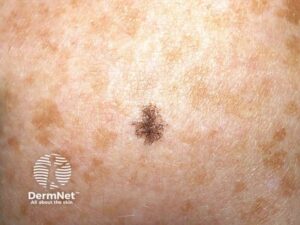
Solar lentigines are also commonly referred to as:
- Liver spots
- Age spots
- Sun spots
- Senile freckles
Who gets solar lentigo?
Solar lentigo is associated with the following:
- Advancing age
- Most frequently seen in middle-aged and older adults, reflecting cumulative photodamage.
- Uncommon in children under 12, except in cases of significant sun exposure or if the child has xeroderma pigmentosum.
- Lighter skin colour (Fitzpatrick skin phototype I or II)
- May be found in up to 90% of Caucasians over the age of 60.
- Also common in the Asian population, where they tend to present on the face.
- Sunburn
- Can appear on sun-damaged skin after an acute sunburn
- Use of sunbeds and certain forms of phototherapy (eg, psoralen and ultraviolet A).
What causes solar lentigo?
Solar lentigines occur due to chronic exposure to ultraviolet radiation.
While the exact pathogenesis is not fully understood, UVR is thought to cause mutations that enhance melanogenesis (melanin production) and melanin retention within keratinocytes. While melanocytic activity is increased, a key feature of solar lentigo is that the number of melanocytes within the basal cell layer is normal or only slightly increased.
Genetics
Several gene mutations have been observed in both solar lentigo and seborrhoeic keratosis, suggesting a common genetic basis. These mutations include MC1R, SLC45A2, FGFR3, PIK3CA, IRF4, RALY/ASIP, and BNC2.
Solar lentigines can also occur as part of genetic syndromes such as Noonan syndrome or Peutz-Jeghers syndrome.
What are the clinical features of solar lentigo?
- Most commonly located on sun-exposed areas eg, dorsum of hands, forearms, upper body, and shins
- Well-demarcated flat or slightly raised lesions
- Irregular, round, or oval in shape
- Colour ranges from yellow, tan, dark brown, or black, but individual lesions are typically uniform in colour
- Size varies from several millimetres to centimetres
- Lesions can be individual (discrete) or they may merge (coalescent)
- Surface can be rough/scaly to palpate due to epidermal thickening
- Surrounding skin may display other signs of photodamage eg, senile purpura, idiopathic guttate hypomelanosis
Solar lentigines are asymptomatic and do not cause itching or pain. Unlike ephelides (freckles), which disappear or substantially fade during winter, solar lentigo persists year-round, though it may slightly darken in summer.